Posts

oxford at taylor square

Image
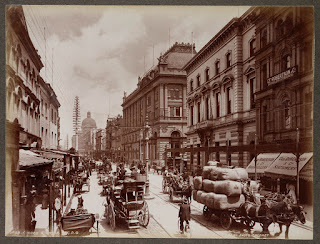
Oxford St at Taylor Square, 1928. The place is jumping with commerce and merchants. It even had three department stores, long since gone. To do this gorgeous picture justice you really, really have to click on it. There's a couple of strong lads unloading Schweppes soft drinks at left, and ladies in cloche hats waiting at the precarious tram stop in the middle of the road, as vintage cars, trucks and horse drawn carts trundle by. All the buildings above are still there, bar the one on the furthest left, McIlwains, which burnt down in the fifties. Although both the cupolas, on the Oxford Hotel, left, and the far building in the centre of the picture, were replaced by billboard hoardings mid century. Maybe I should have waited till winter to take this pic, when the deciduous trees don't obscure how relatively intact is the scene architecturally. But it's like most modern views these days, devoid of its former unique character. Now it's just a thoroughfare through a n...

taylor square, darlo

Image
From a seriously rutted Oxford Street at Taylor Square, we're looking up Forbes St past the gaol that was still functioning at the time (which later became East Sydney Tech, and now the National Art School). It's 1870 (!) On the culvert is a gas lamp, what's possibly a policeman, but I can't figure out the purpose of that thing that looks like an urn on a post. Too small for mail (or is it?), no spout for water, too grand for a hitching post. Any ideas? ( click for the huge original. ) The modern view of the same site is obscured by an abandoned substation built after Federation, and of course Sydney's ubiquitous trees. The conversion to a square was made earlier this century, after the Eastern Distributor tunnel was completed directly underneath. And if you thought this photo wasn't taken in exactly the same spot as the first because the opposite corner is further away, during WWI Sydney Council demolished the entire northern side of Oxford St to make ...

st johns, darlinghurst road

Image
This evocative pic comes via a National Archives newspaper series about a 1928 celebrity wedding; a hyphenated groom and his bride I'd never heard of, but who'd attracted quite a crowd of middle-aged ladies prepared to wait in the rain outside. Anyhoo, St Johns CofE, on the border of Darlo and Kings Cross, in a time when the former was somewhat down at heel and the latter bohemian, in the classy sense. This picture captures one of the quintessential differences for those of us who grew up in Sydney pre-1980, and its contemporary version. The views. Great sweeping vistas of them, all over the place. Now ... Precisely the same spot, eighty years after, [ albeit a foot or two higher due to my stature.] Today, trees form a universal barrier to Sydney's cornucopia of sublime panoramas and glorious history. Planted without foresight or design, council by-laws prevent any attempt to restrict their impact. They've not simply been allowed to take over, but have been activel...

george at king

Image
This evocative pic positively jumped out of the archives, did an arabesque, up tempo cha cha, swivel and point, and pleaded, "Blog me!". Do click on it for the full size glass-plate original to capture the real atmosphere of what's going on here. This is 1890s George St, when it was a genuine main road connecting the working wharves of Circular Quay to the rest of the industrial port city.   While the dome of the Queen Victoria Building is now obscured by Sydney's ubiquitous 1960s internationalism, the old building on the corner is the sole survivor in view. It's Victorian Gothic facade had an Edwardian makeover it seems, the textured sandstone and decorative entry simplified perhaps not long after the first photo was taken. It's also had two floors added on top, and the window pediments strangely swapped; triangular for curved and vice versa. It must have made sense at the time. Zoom into the original to get an extraordinary essence of Sydney's dyna...

t&g building

Image
The T&G Building was an early Sydney skyscraper, on the corner of Elizabeth and Park Streets. Here it's going up in the early 1930s. And here completed, though not for very long. Below are street decorations for the Queen's visit in 1954. And below is the 50 storey T&G Tower that replaced it less than forty years later. Aren't we lucky. ...Further photos below I've since found. Do click on each image to enlarge it (then click on it again for its full size.) The details are great.

the rural bank

Image
"If the primary activity of the nation was erection, improvement and expansion of buildings and land then, with few exceptions, the perceived or actual worth of the land was the only criteria by which it could be judged, and if the buildings were in a vernacular that was of another place and time, and were worth more demolished than standing then down they came." Garrett, P. ‘National Estate or Real Estate: Crunch Time for the Harbour City’, 1999 http://www.nsw.nationaltrust.org.au The Rural Bank Building in Sydney's Martin Place was a granite and sandstone shrine to high art deco. check out those friezes in the main banking chamber. The lift lobby was detailed in brass trim. Even though it's architectural value was fully recognised and there'd been a campaign to save it, in 1985 it was pulled down to make way for this . I remember I went for a final sightsee, like many others, just weeks before. All that I know of that's left of it are the rams' heads...

pre-modern and modern

Image
These pics are from a NSW museum exhibition series. The one above is a Redfern family evicted in 1934. That's their "meagre possessions" on the footpath. He was a Gallipoli vet. This was taken only twenty four years later, on a new Dundas estate, but it may have been another world in comparison. It gives a sense though behind the twentieth century enthusiasm to demolish the drear and drudge of the past and concrete it over with sparkling new modernity. Yet so much was successfully eradicated that what's left is coveted.