Posts

Barangaroo 1865

Image
This is an awesome pic of a ship-builder because it's so early in Sydney's photographed history, and look behind. I've spliced two old stereographs together and enhanced the details. Top left on the hill is Sydney Observatory, and top right is the church tower of St Philip's, both still intact today. The steep cliffs and shoreline have been redeveloped many times over many decades so that today they're unrecognisable from the original. And how do we know we're in the same spot as the photo above? Triangulate the Observatory tower and its west dome, and they match. Google Street View (clickable).

Bond Street, Sydney 1898

Image
This is how Sydney generally used to look in the C19th. So much of it was swept away in the 60s and 70s for mass modernism, before it was collectively realised how much history, beauty and heritage had been lost. It's still going on, just to a lesser extent. I enhanced the photo from a very dark original which is why it looks a little patchy. Some of the detail had been lost in the under-exposure. Anyway, from the same corner as above. Google Street View (clickable).

King Street at York 1865-1959

Image
The same spot on King Street across 150 years. In 1865, a quiet colonial outpost, just like a big country town. But prosperity and commerce are growing, real estate increasingly in demand. 1885. Post gold-rush, and mass immigration from the poorer parts of the UK has jumped over the preceding decades. The wealthy of the colony keep consolidating, and the main streets are full of substantial sandstone buildings. This is when Sydney starts to get its large Victorian edifices that we know today. 1959. The city has had a 10-storey height limit imposed since 1910. This restriction has just been lifted, and the charming-scale streets will soon be largely decimated and replaced by modernist and post-modernist goliaths. Google Street View (clickable)

Hyde Park 1928

Image
I'm putting up this photo mainly because it's so beautiful (it enlarges magnificently). It's an evocative Hyde Park around 1928, possibly by Cazneaux by the look of it, with the silhouette of the David Jones department store behind, and the cupolas of the Trust Building on King Street beyond. The Archibald Fountain won't be constructed in front for a few more years. You know, I remember when it was still common to see old men with nothing more to do than sit on park benches. A different world. The same spot on Google (clickable), with probably the same Moreton Bay fig behind those people sitting in the middle.

Martin Place 1940

Image
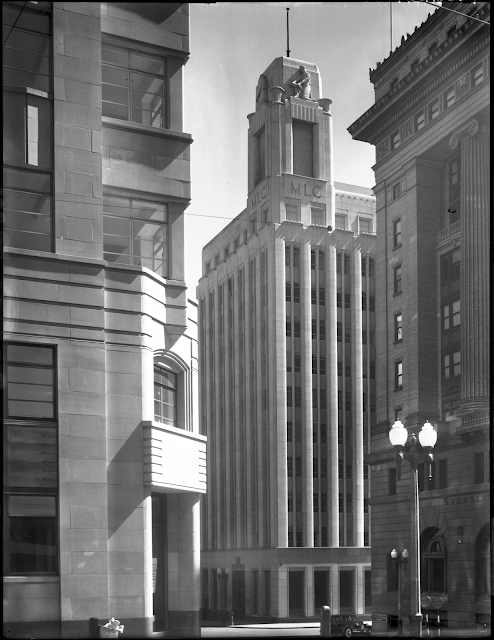
A beautiful artistic shot. At right - Commonwealth Bank 1928; centre - MLC Building 1938; left - Prudential Building 1939 (it only lasted twenty years before a brutalist monstrosity replaced it, itself now happily demolished for the new metro station.) Google Street View (clickable)

Pyrmont Bridge 1962

Image
Looking west from Market Street. It gives an indication to modern eyes that Sydney then was still an industrial city with a working harbour. I remember a lot of grit and grime around the harboursides and inner city, old buildings blackened from decades of smoke and smog. Now everything is spruced and restored, so you'd never know. In a previous post, I mentioned that Pyrmont Bridge was the main western entry to the city, and crossing point to the Eastern Suburbs, now replaced by tunnels and overpasses. This picture looks like morning peak, there are rows of double-decker buses on the bridge heading in. And of course today (clickable). While the bridge is still there, it's been pedestrianised, and its off-ramp made way for the Western Distributor which cuts through.

Hyde Park 1943

Image
War-time Sydney. This air-raid shelter was on the park's south side near Park St, beside the avenue of figs. You can make out the bulk of the, I think, YWCA on Liverpool St behind the sign on the right. And same spot today, over there by the trees behind the lamp post. This 1943 aerial shows it, those diggings in the centre beside the avenue of trees.